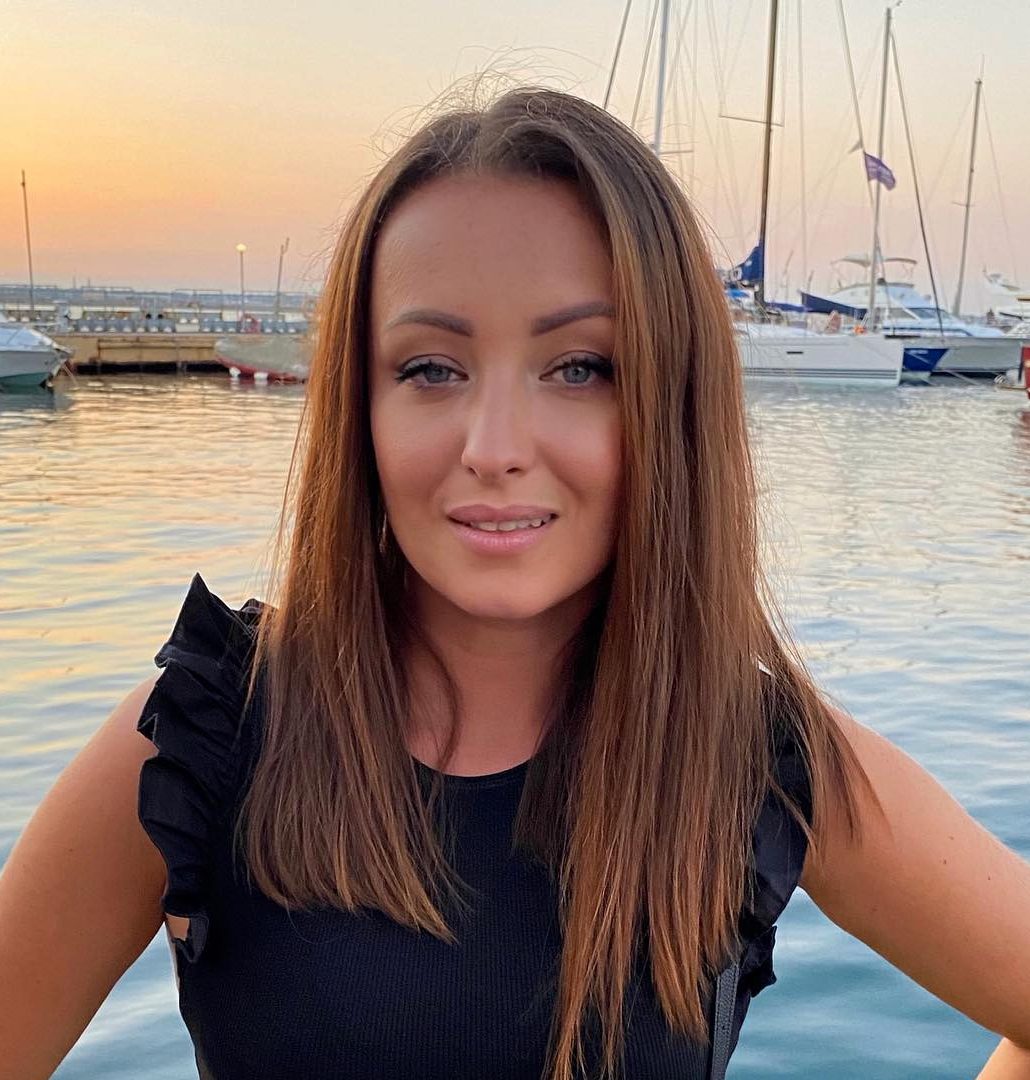
Honey blonde is the color equivalent of a well-worn leather jacket: warm, forgiving, and somehow always in style. The shift this season is toward lived-in dimension, with root shadows and hand-painted highlights replacing single-process uniformity.
These 34 examples run the gamut from a low-maintenance balayage to a full highlight schedule, covering every length from a chin bob to mid-back. If your fine hair disappears into a single shade or your grow-out line shows up at week three, this collection has a fix. Honey Blonde works because it adapts to your texture and your patience level, not the other way around.
Shoulder Length Honey Blonde With Root Shadow
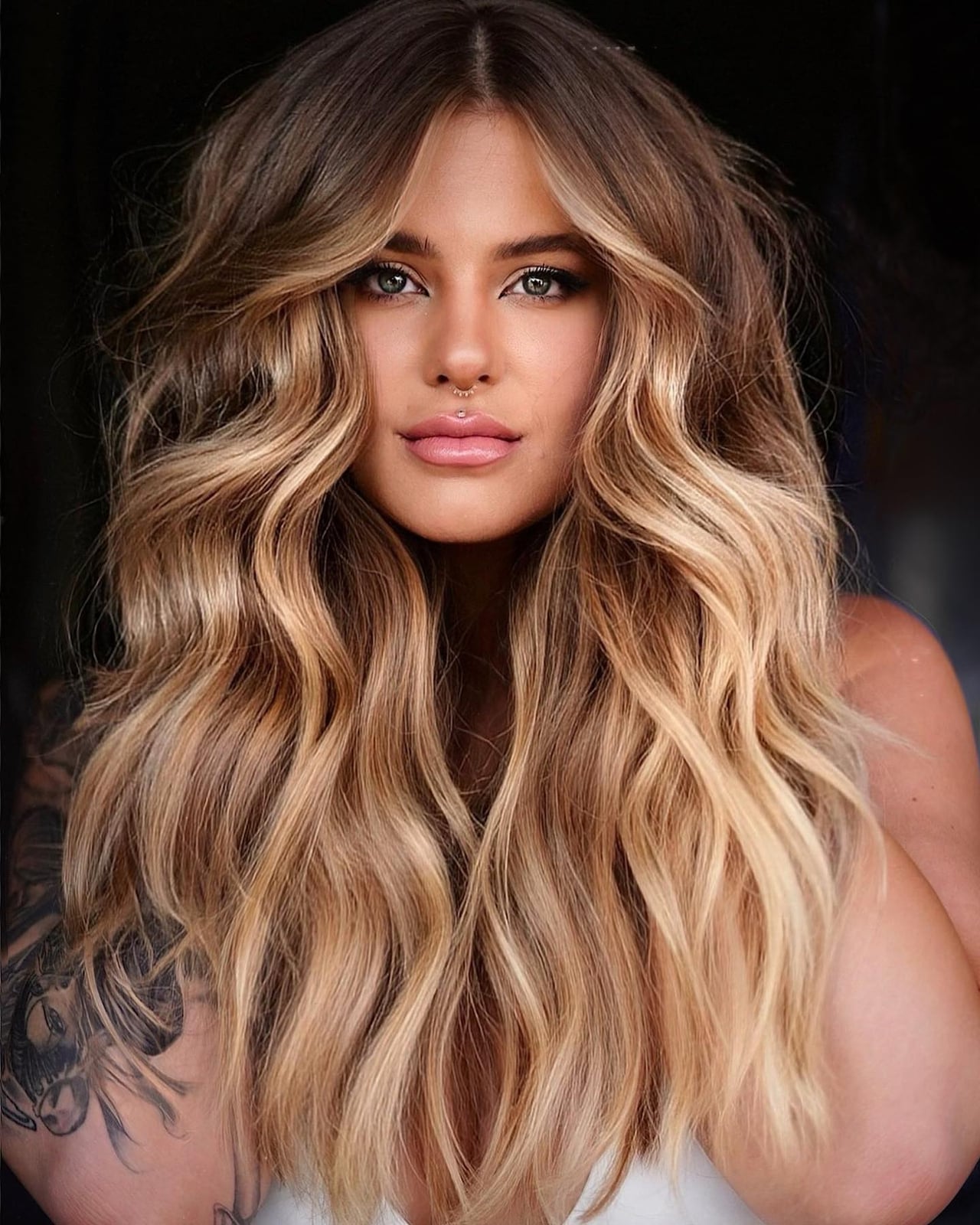
What is that seamless transition from darker root to lighter ends? The root shadow here creates a soft, lived-in line that means you can skip the salon for a few extra weeks. This shoulder-length cut with face-framing bangs and a middle part works best on thick, wavy hair and helps elongate round faces. Ask your colorist for: shoulder length honey blonde with root shadow and face-framing bangs. A blowout adds volume, and the layers need a trim every six to eight weeks to keep the shape tidy.
Mid-Back Length Honey Blonde With Dimensional Highlights
The trick here is the blend of honey blonde base with lighter pieces woven through the ends. It is not a single flat shade; the contrast gives the hair depth and movement, especially when styled in loose curls with a side part. This approach suits thick, wavy hair and can add perceived volume to finer textures. Ask your colorist for: mid-back honey blonde with dimensional highlights and loose curls. A large barrel curling iron builds the shape, and a toner refresh every six to eight weeks keeps the tone from turning brassy.
Maintenance is moderate. The highlights grow out softly, so the root line is not harsh, but the lighter pieces will need a toner refresh to stay bright.
Golden Honey Blonde Balayage With Curtain Bangs
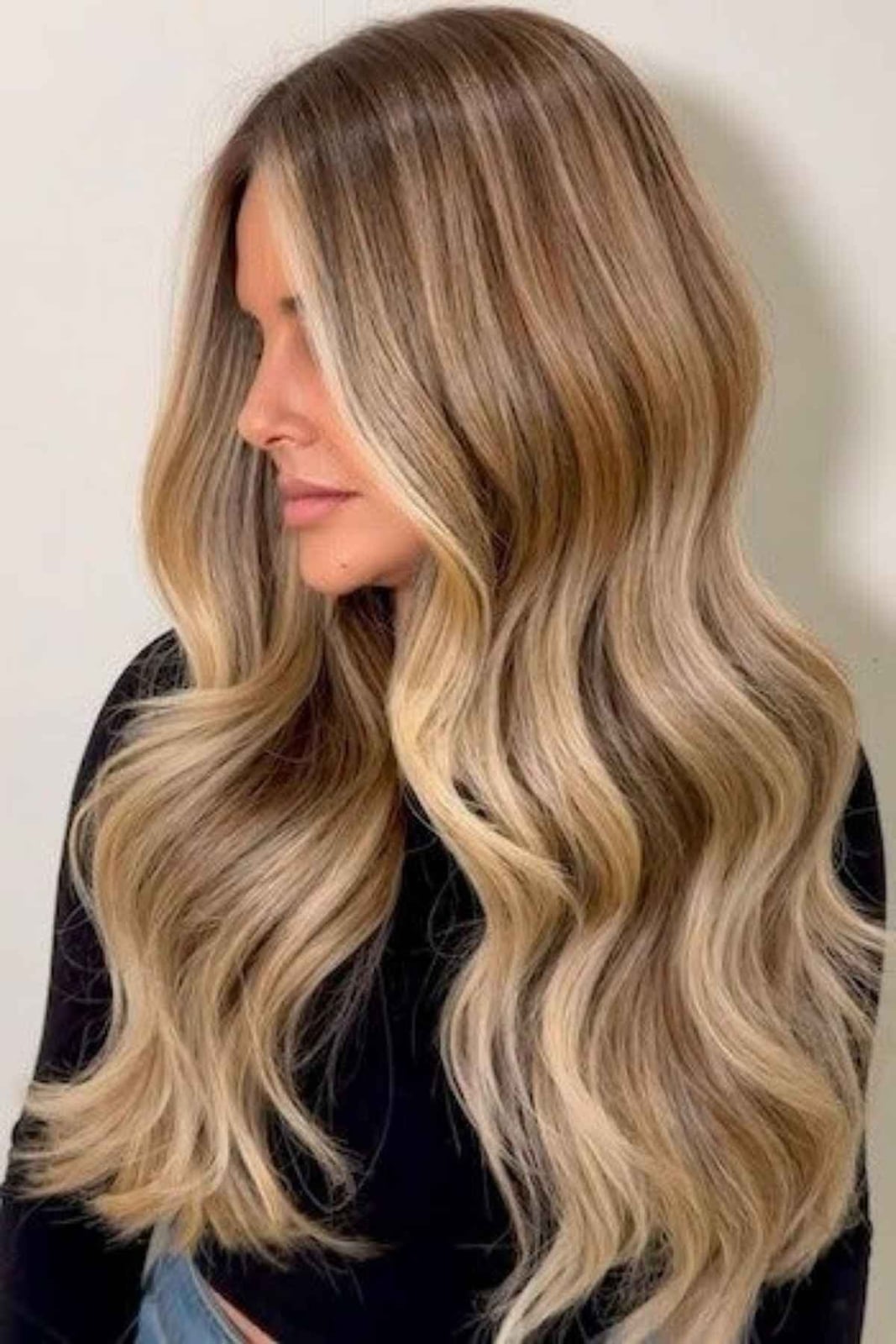
Think of this as the warmer cousin to a cool, beige balayage. The golden honey tone leans amber rather than ash, which makes it a solid choice for anyone who wants brightness without going platinum. The curtain bangs and mid-back length work well on thick, wavy hair and soften square or oval face shapes. Ask your colorist for: mid-back golden honey blonde balayage with curtain bangs. A round brush and blow-dryer create the soft wave at the ends. The balayage technique means touch-ups are needed less often than traditional highlights, making this a practical choice for everyday wear or the office.
Shoulder Length Golden Blonde With Blunt Bangs
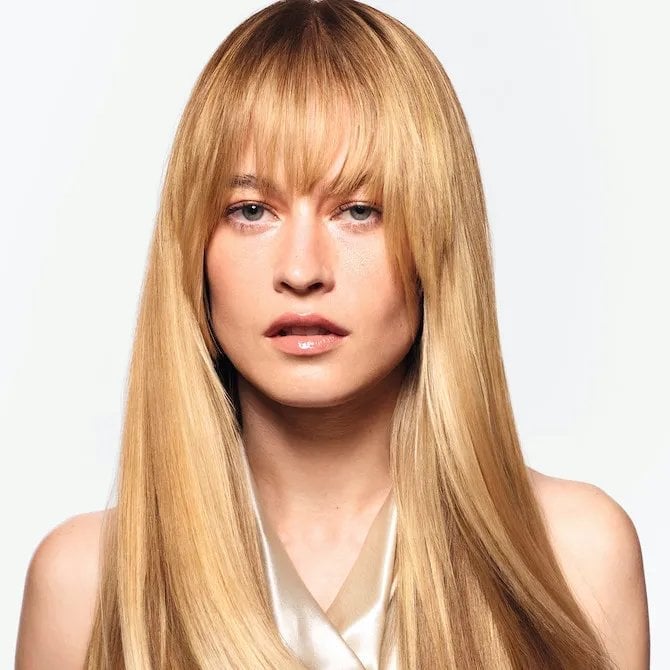
The blunt bangs and straight, smooth finish are the defining features here. This golden blonde shade is applied evenly, and the fine, straight texture keeps the look clean rather than fluffy. This cut suits oval and long face shapes best, because the blunt line adds width. Ask your stylist for: shoulder length golden blonde with blunt bangs. A flat iron seals the smooth finish, but the bangs need a trim every two to three weeks to stay precise. The fine texture holds the straight line well without extra product.
Mid-Back Honey Blonde Balayage Lived-In Effect
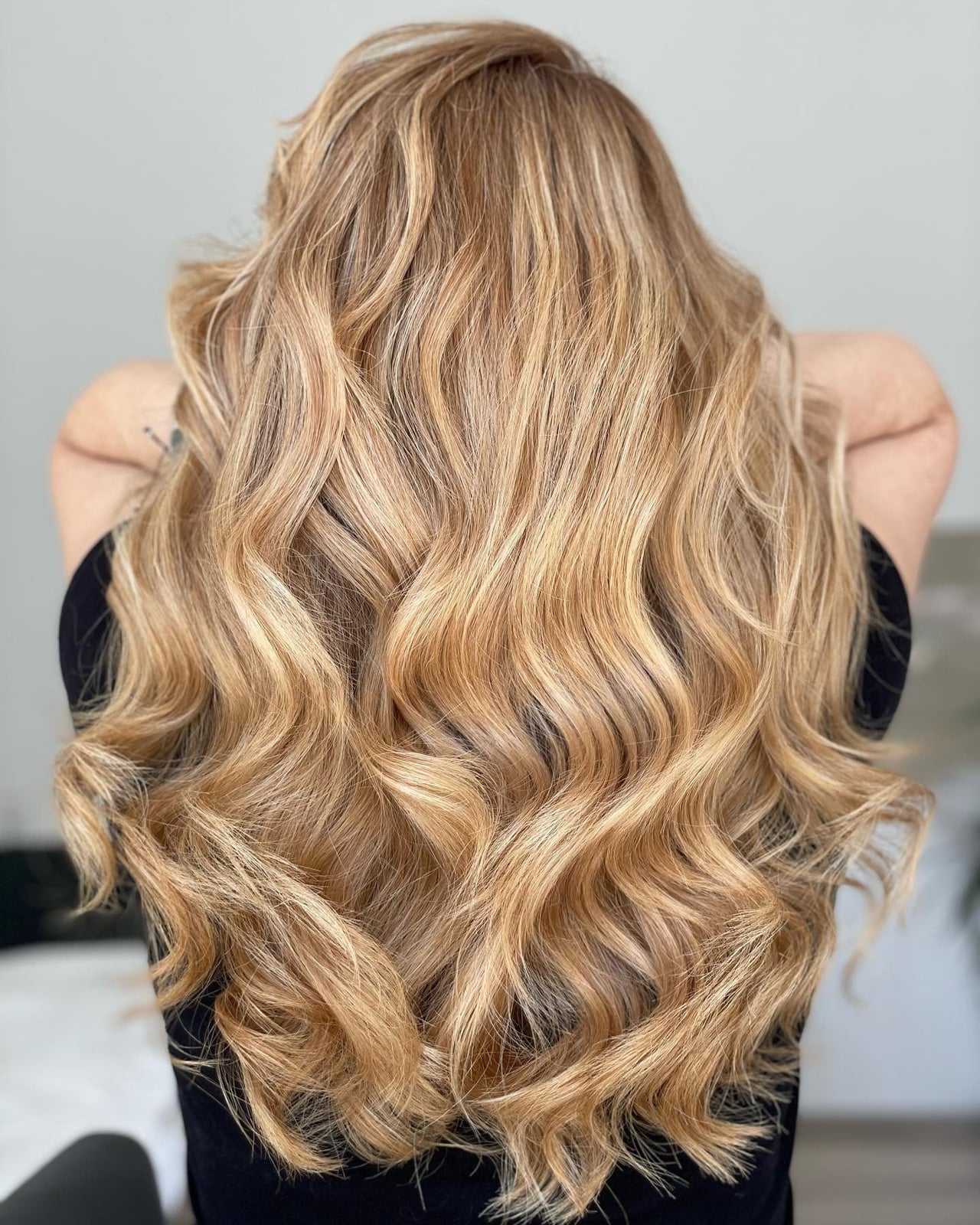
The back view shows how the honey blonde balayage is painted over a darker base, leaving the root area untouched. This deliberate contrast creates the lived-in effect that grows out gracefully. It is a salon technique because the colorist must hand-paint each section for a natural transition. Ask your colorist for: mid-back honey blonde balayage with a lived-in effect. Thick, wavy hair at mid-back length is the ideal canvas; the waves catch the lighter pieces and emphasize the dimension. At home, air-drying with a texture spray encourages the natural wave pattern.
Collarbone Honey Blonde Glossy Finish
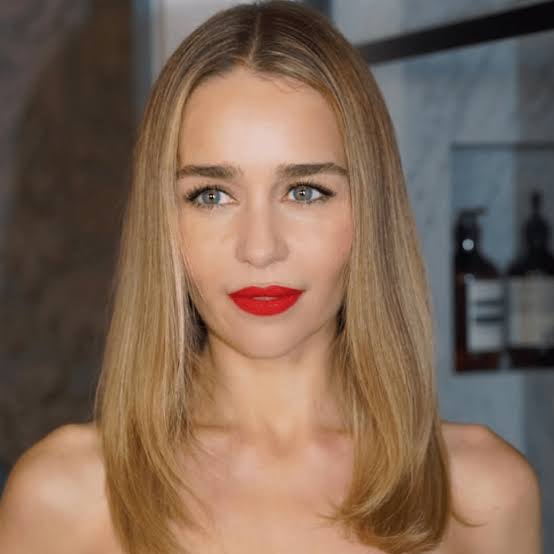
Can you get a salon-level gloss from your own bathroom? Yes, if you start with the right canvas. Fine, straight hair at the collarbone takes a uniform honey blonde shade well, and the middle parting keeps the line clean. Ask your colorist for: collarbone length uniform honey blonde with a glossy finish. Apply a shine serum to damp hair and let it air dry; the natural texture does most of the work. The catch: that high-gloss look fades faster on un-toned hair, so plan for a gloss treatment every four weeks or the warmth veers brassy.
Mid-Back Honey Blonde With Subtle Dimension
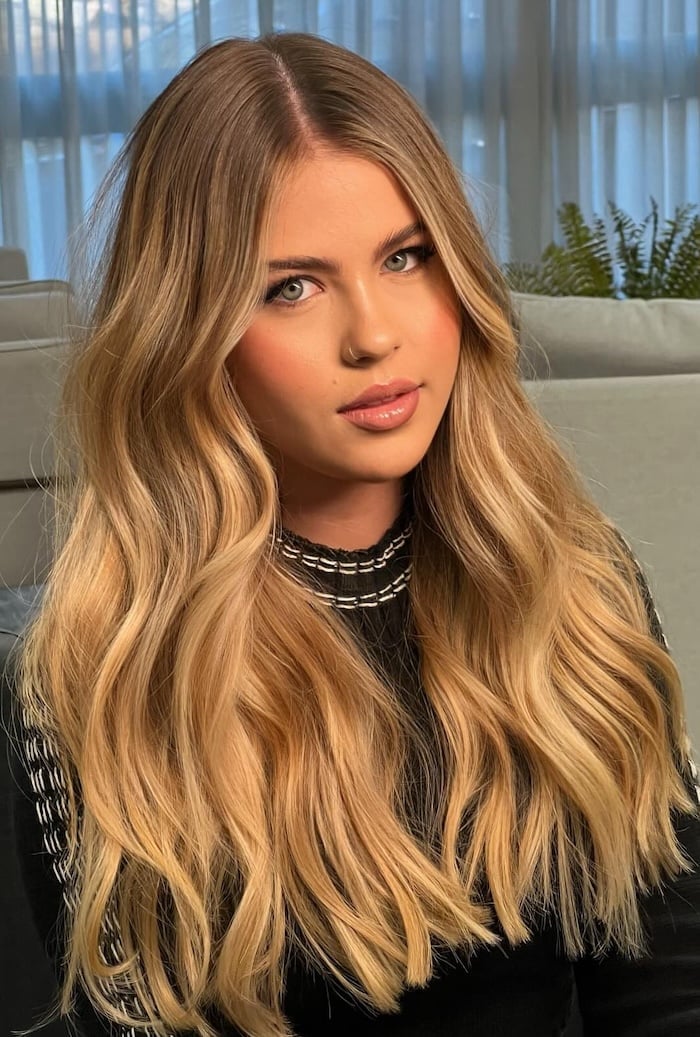
The rule with dimensional color on thick, wavy hair is that more is not better. A rich honey blonde base with subtle highlights can look natural. The mistake is asking for too many high-contrast pieces, which turns the soft dimension into a stripe situation. Ask your colorist for: mid-back rich honey blonde with subtle dimensional highlights. The loose waves and middle parting let the lighter strands show without competing. Enhance natural waves with a texturizing spray. Tone every six to eight weeks to keep the warmth from shifting too orange.
Collarbone Honey Blonde With Side Swept Bangs
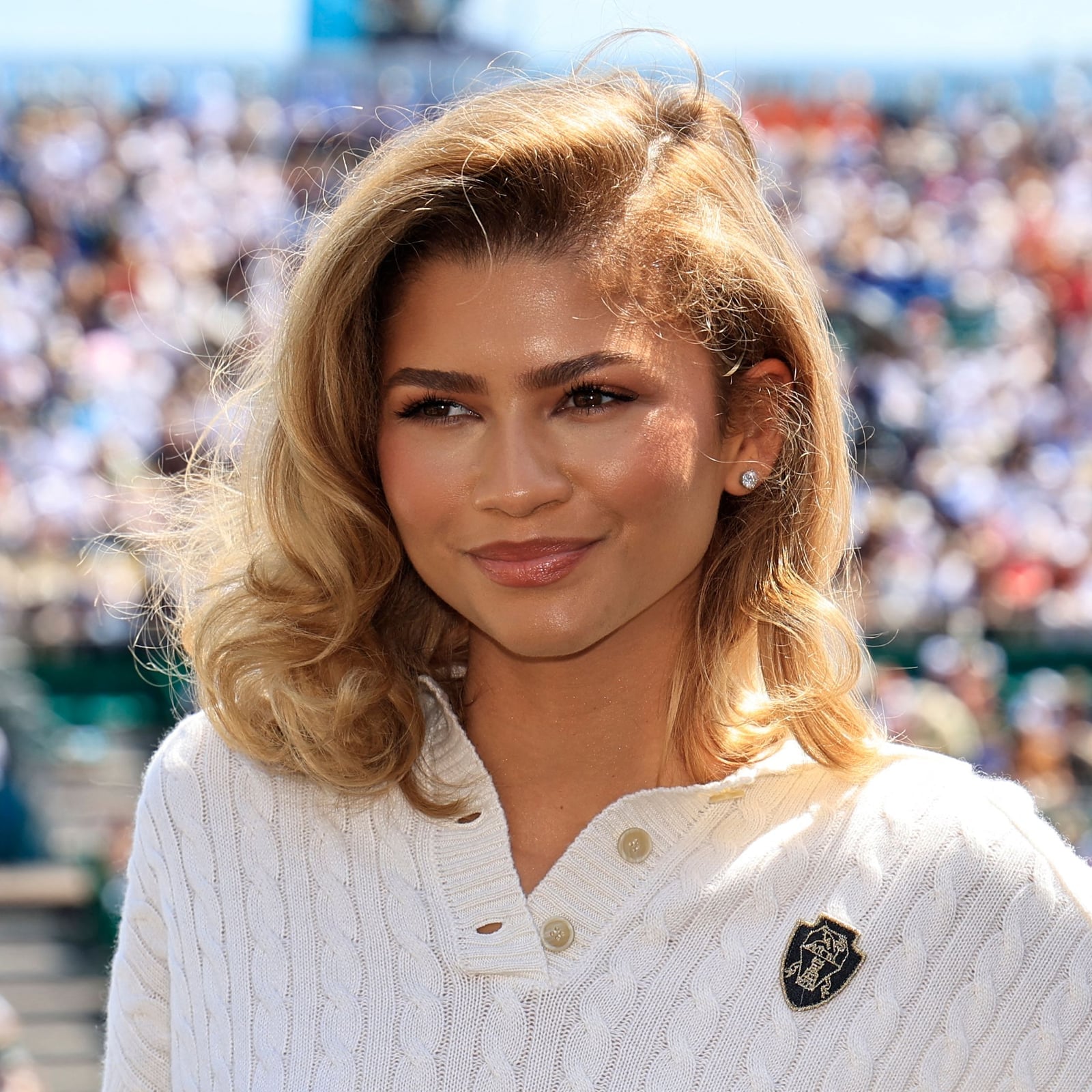
A side swept bang can feel like a throwback, but on collarbone length honey blonde hair with a glossy blowout, it looks modern and intentional. The side parting and soft waves give the thick texture enough weight to hold the sweep. Ask your colorist for: collarbone length honey blonde with side swept bangs and waves. This works for fall through spring: the warm shade offsets gray skies, and the blowout adds enough structure for a work presentation. Tuck the bangs behind one ear when you need a cleaner line.
Shoulder Honey Blonde Balayage Blowout
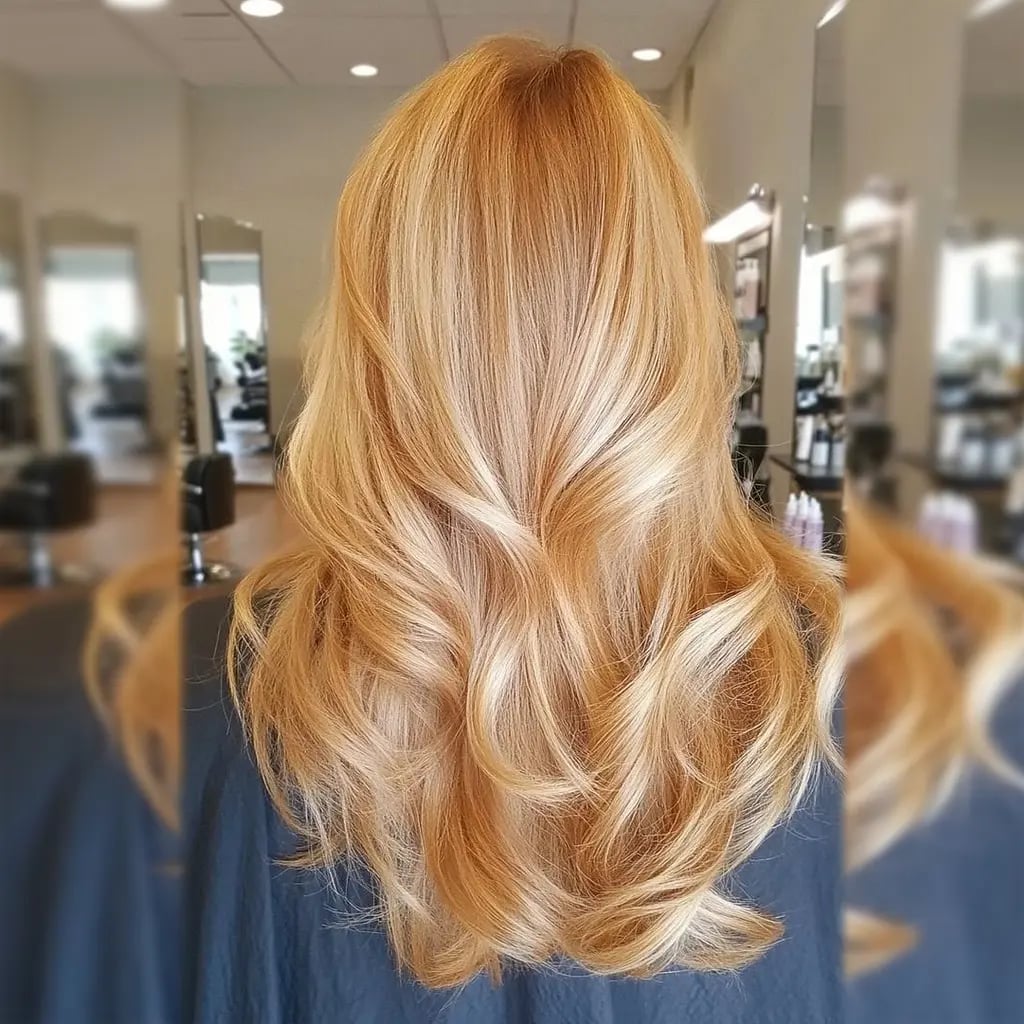
The back view here tells you everything: the balayage sweeps lighter through the mid-lengths and ends while the root stays deeper, which gives the shoulder-length cut a sense of movement. The voluminous blowout with loose waves spreads the warm honey blonde tone evenly. Ask your colorist for: shoulder length warm honey blonde with balayage and volume. To recreate the shape at home: use a round brush on damp hair, blow-dry each section away from the face, then wrap sections around a large-barrel iron for five seconds each. Brush through with a paddle brush for soft, blended waves.
Collarbone Honey Blonde With Subtle Highlights
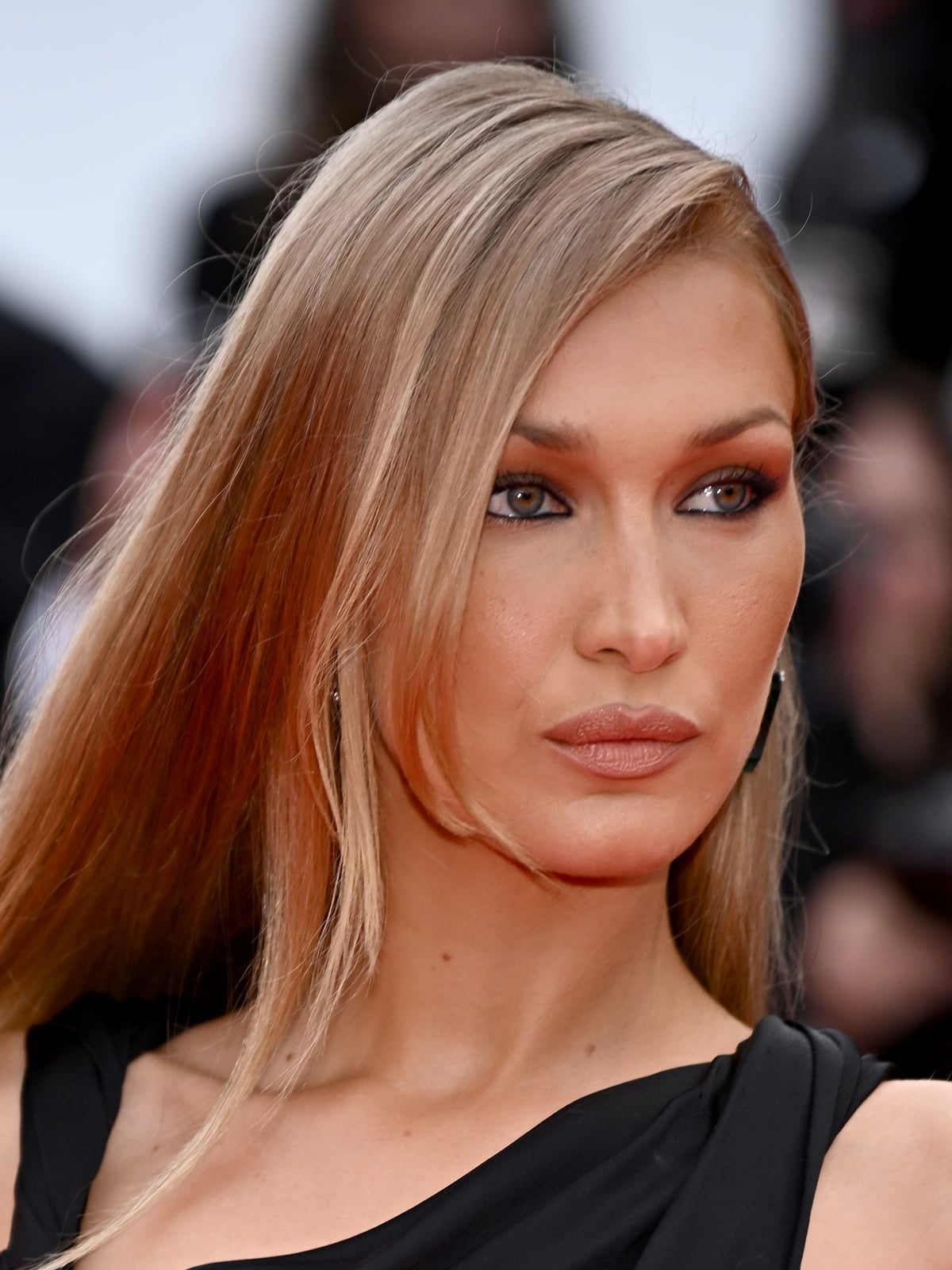
Fine, straight hair at the collarbone can look flat in a single-process color. The fix is subtle highlights that add dimension without the weight of heavy foils. The honey blonde base stays uniform, and the lighter pieces are fine enough to read as texture rather than stripes. Ask your colorist for: collarbone honey blonde with subtle highlights and a glossy finish. A smoothing serum keeps the straight blowout sleek. The trade-off: subtle highlights fade faster than bolder ones, so plan for a toning gloss every six weeks or they blend back into the base entirely.
Collarbone Dark Brown With Honey Blonde Highlights
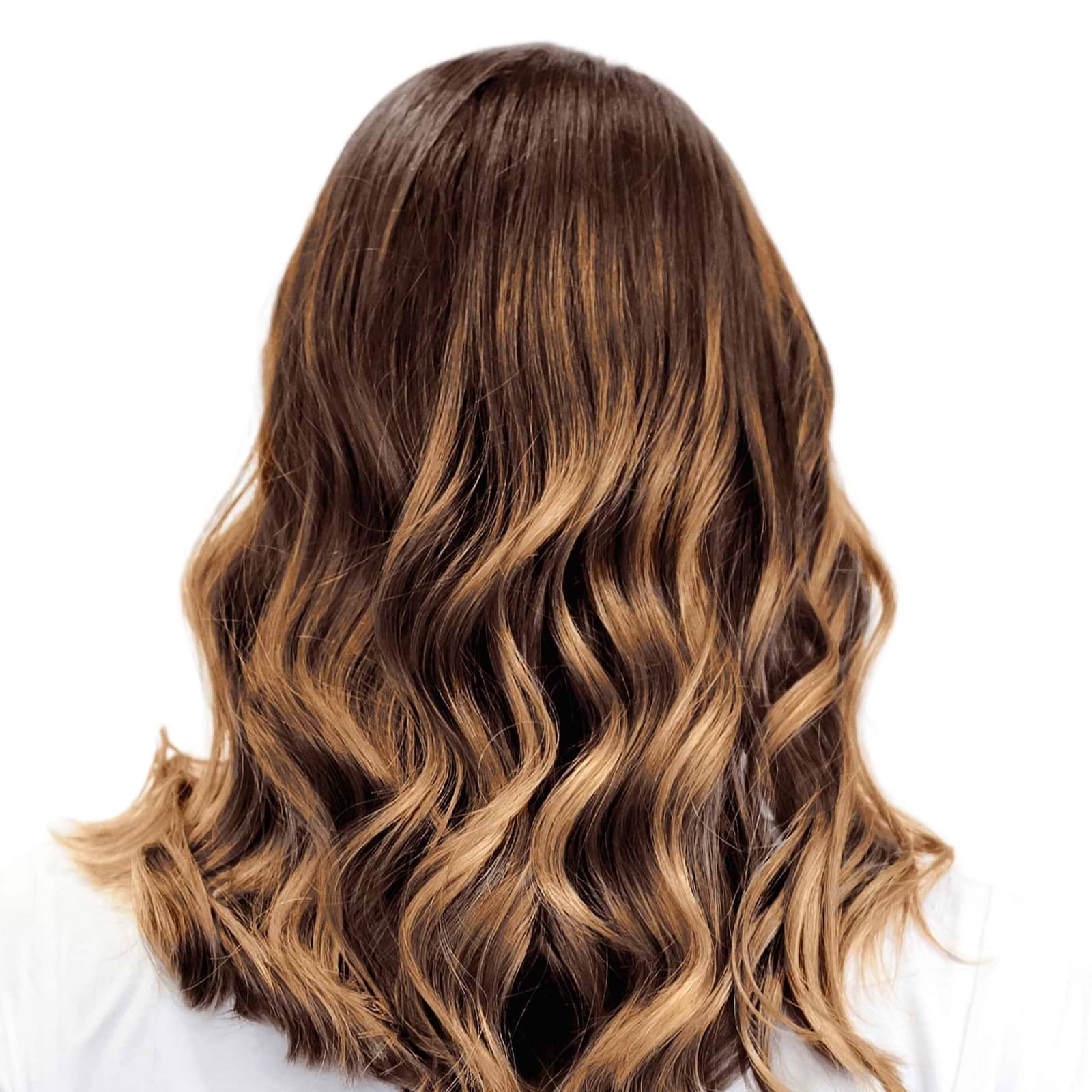
A full honey blonde is one thing, but a dark brown base with honey blonde highlights is a different animal entirely. The contrast here does the work: the warm highlights look deliberate, not faded, because they sit against a deep, cool-toned backdrop. This suits thick, wavy hair starting at the collarbone. The darkness gives density weight, while the lighter pieces keep it from looking heavy. Ask your colorist for: collarbone length dark brown with honey blonde highlights. A wavy blowout and a gloss treatment every six to eight weeks keep the shine high and the brassiness low.
Mid-Back Honey Blonde Balayage
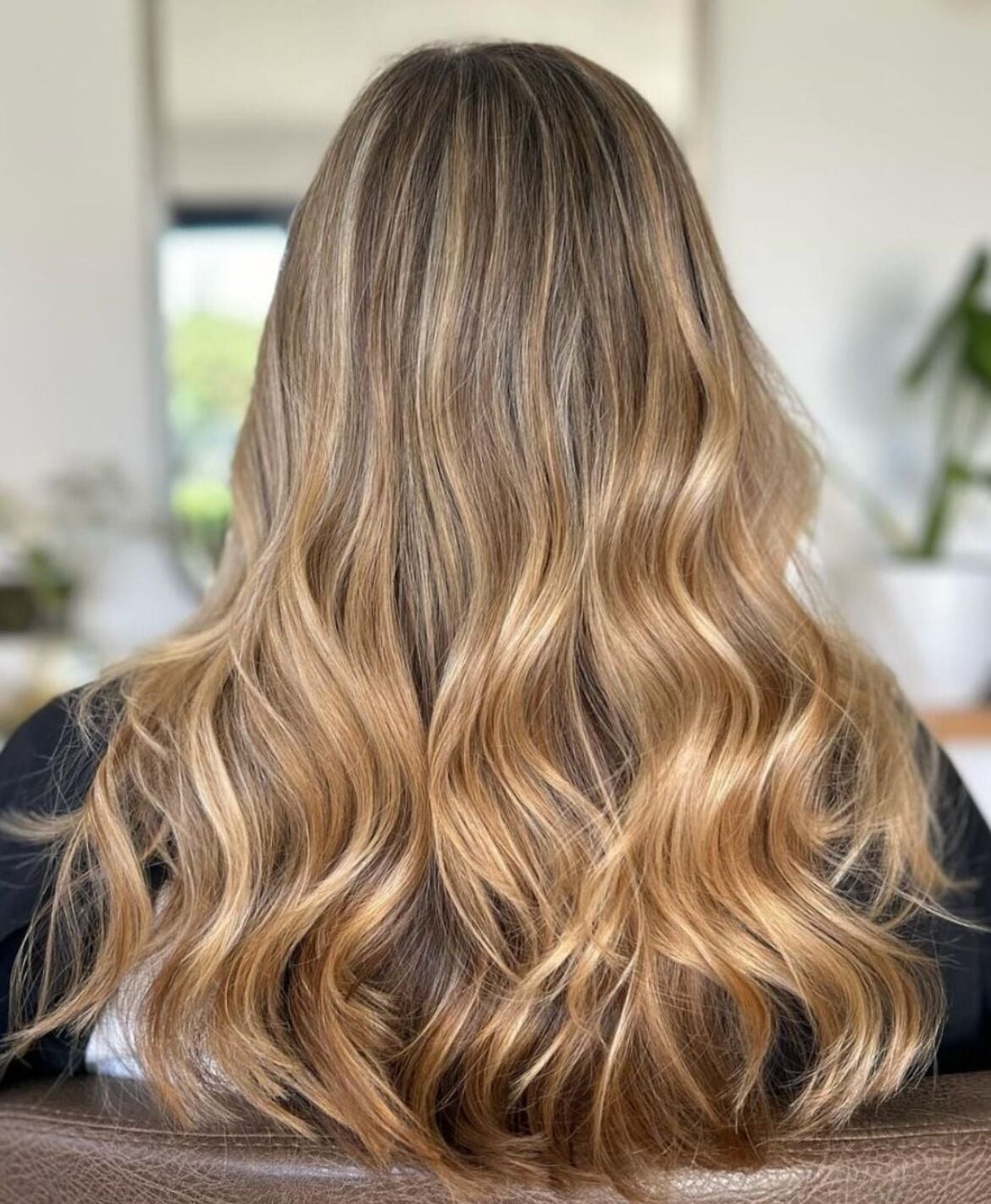
The design here hinges on the transition: the honey blonde balayage starts a few inches from the root and softens into the ends, so there is no harsh line where new growth meets color. That smooth fade is what makes it lived-in from day one. It works on thick, wavy hair at mid-back length, where the loose waves catch each painted section and break up the tone naturally. Ask your colorist for: mid-back honey blonde balayage with warm tones. Because the root is untouched, touch-ups land every ten to twelve weeks instead of six. A texture spray and a blow dryer with a diffuser attachment bring out the wave pattern without extra effort.
Balayage is not a single technique. It is a placement strategy. The colorist hand-paints each section, varying the thickness and spacing so the highlights look organic, not striped. On this length and texture, the result is dimension that moves with the hair, not sits on top of it. The warm honey tone adds a glossy finish that looks healthy, not brassy, as long as you use a toning shampoo once a week.
Mid-Back Deep Honey Blonde With Ribbon Highlights
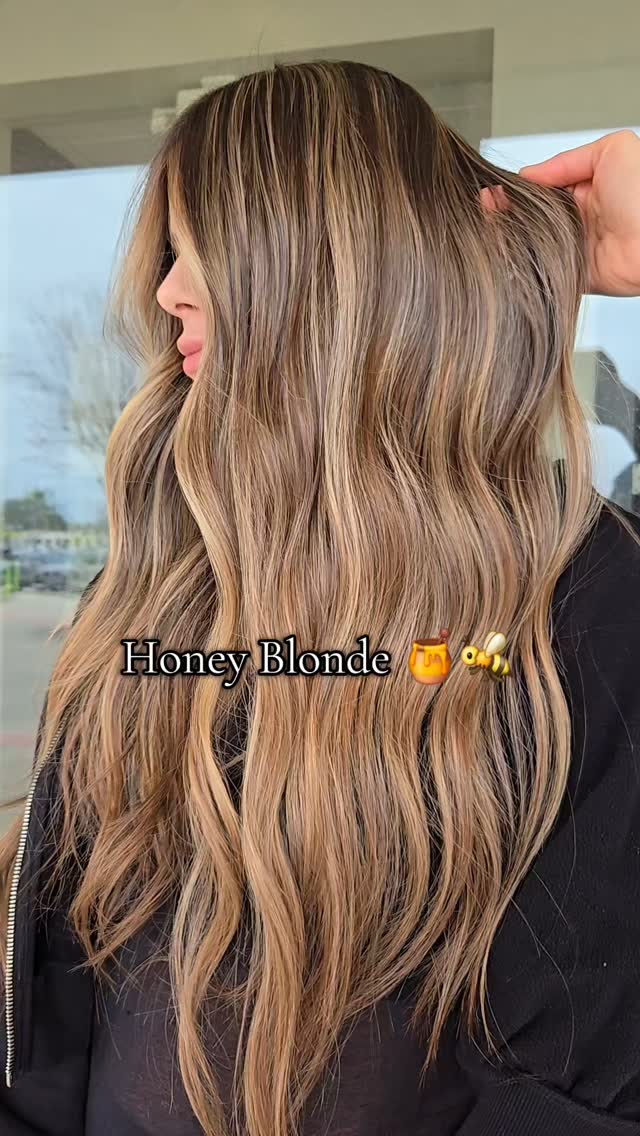
What exactly are ribbon highlights? They are thicker than a babylight and wider than a foil highlight, placed strategically to create a bold, woven effect. On a deep honey blonde base, these ribbons create deliberate chunks of lighter color. The payoff is high contrast without the stripe look of old-school chunky highlights. This works on thick, wavy hair at mid-back length; the loose waves help the ribbons wrap around the shape. Ask your colorist for: mid-back deep honey blonde with ribbon highlights. To get the effect right, specify that you want the ribbons thicker near the mid-lengths and softer toward the ends.
A good stylist will place the ribbons where the hair naturally falls, around the face, along the crown, and through the layers. The deep honey base keeps the overall tone warm, so the lighter pieces do not pull cool or ash. If you are starting from a darker natural shade, expect a two-session lift to protect the integrity of the hair. A toning visit every six to eight weeks keeps the ribbons from yellowing.
Shoulder Honey Blonde With Volume
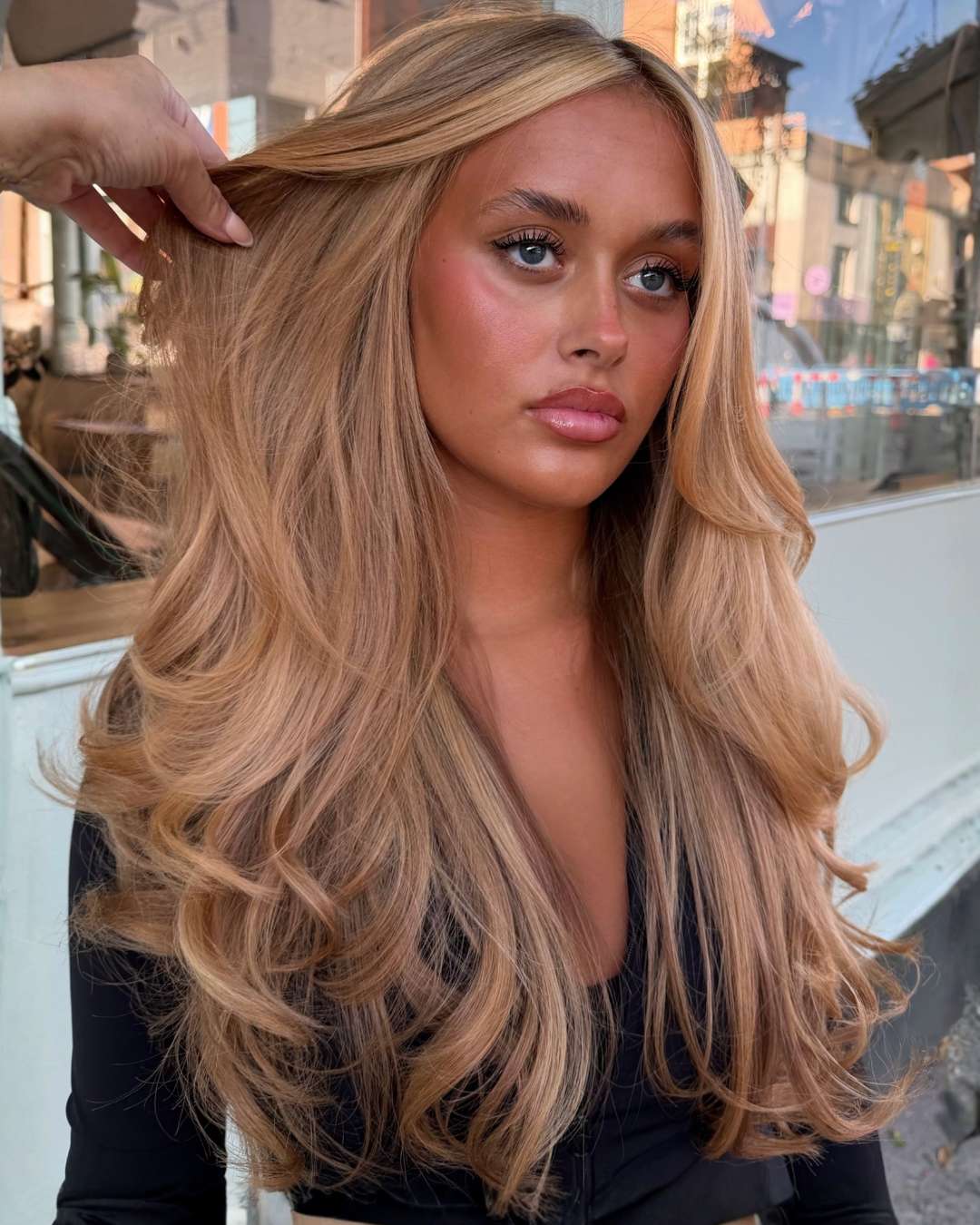
A shoulder-length cut with a voluminous blowout is a test of the color: the honey blonde shade needs warmth to keep the volume from looking flat. Here, the side parting and subtle layers add lift at the crown, and the thick, wavy texture holds the shape without heavy product. This suits anyone with medium to thick density, finer hair might need a root-lifting spray to maintain the height through the day. Ask your stylist for: shoulder length warm honey blonde with volume and waves. A large round brush and a blast of cool air at the roots set the lift for about two days. Trim every six to eight weeks to keep the ends from thinning out.
Collarbone Honey Blonde With Face-Framing Layers
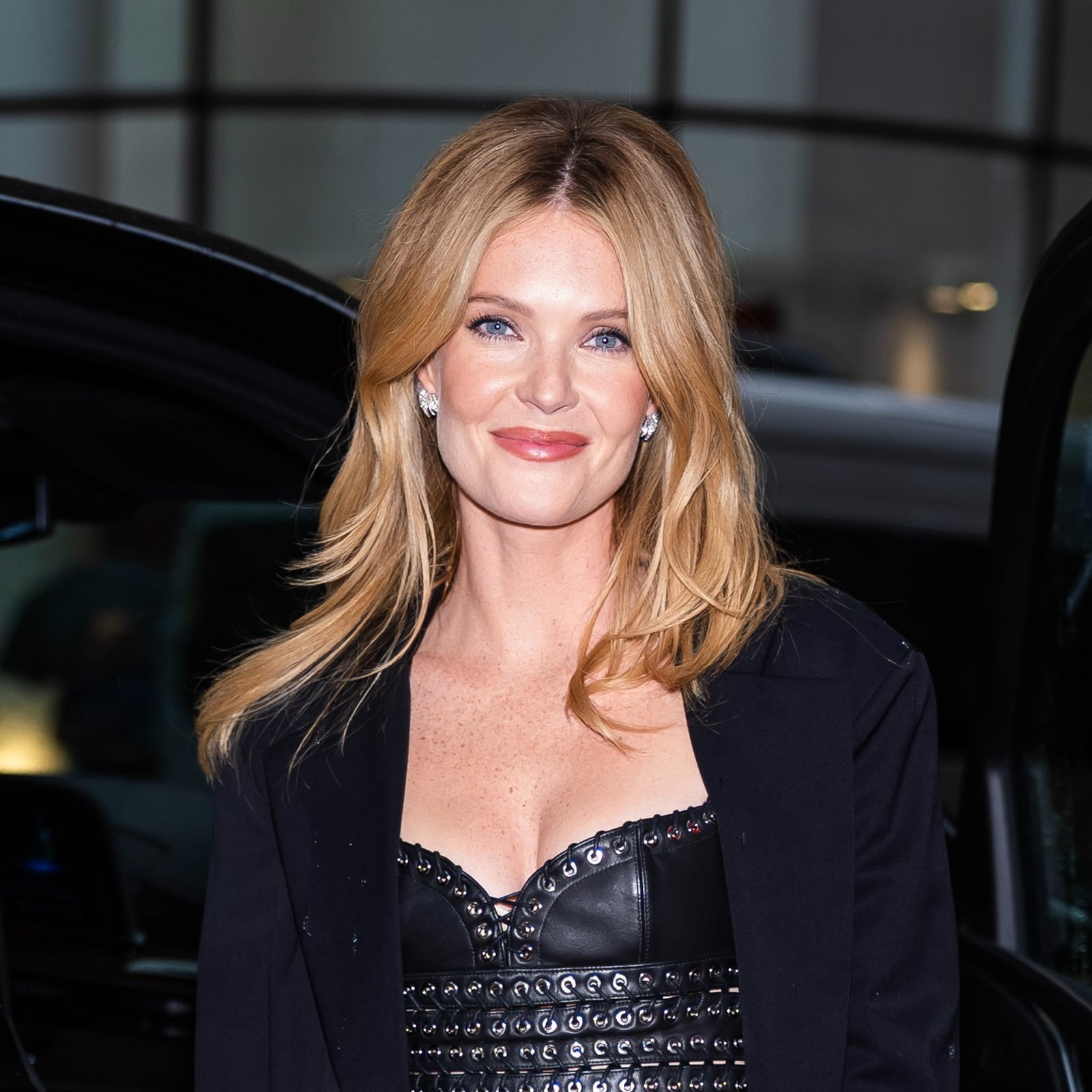
Face-framing layers and curtain bangs change how a honey blonde color wears over time. As the layers grow, the shorter pieces catch the light differently, keeping the color dynamic without a fresh appointment. A middle part and collarbone length make this a strong choice for round or square face shapes; the curtain bangs soften the perimeter without shortening the overall line. Ask your stylist for: collarbone honey blonde with curtain bangs and face-framing layers. Blow-dry the bangs forward with a round brush, then sweep them to each side. The face-framing pieces need a trim every eight to ten weeks to avoid looking shaggy.
Mid-Back Honey Blonde Balayage With Dark Root Shadow
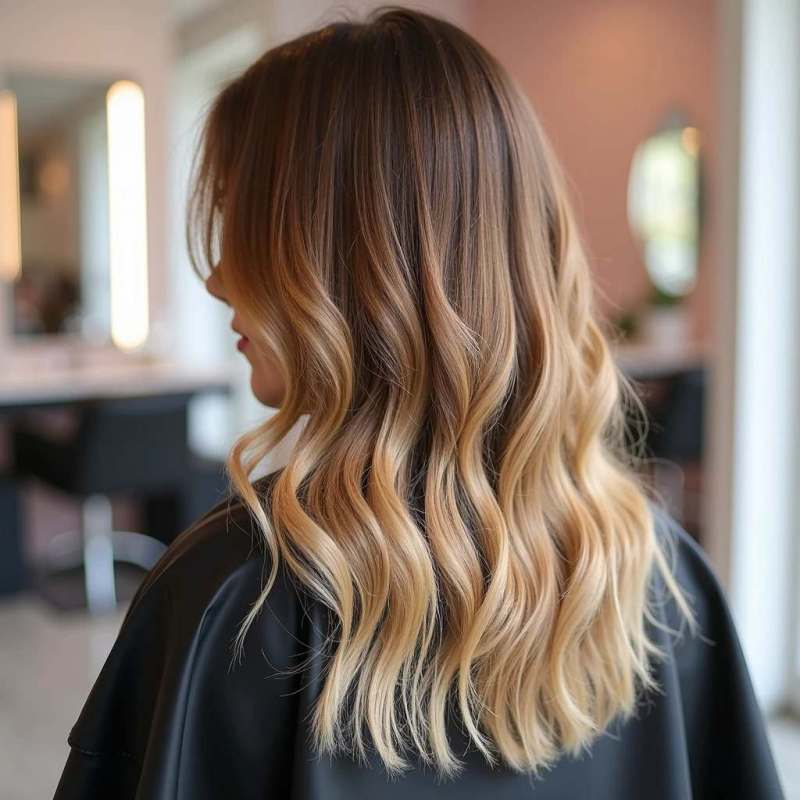
The dark root shadow gives this honey blonde balayage a built-in grow-out that buys you about two extra weeks between salon appointments. Thick, wavy hair at mid-back length carries the transition from a deeper root to lighter ends with natural movement. Ask your colorist for: mid-back honey blonde balayage with dark root shadow. This is not a DIY project: the balayage hand-painting requires a skilled eye to keep the gradient soft and not striped. A middle part helps the lighter sections fall evenly on both sides.
The wavy blowout softens the contrast between the shaded root and the blonde lengths. A salon does this one, and the colorist will need about three hours to lift and tone the ends to the right level. This finish typically lasts two to three weeks before the natural root grows in enough to need a touch-up.
Collarbone Butter Blonde With Face-Framing Highlights
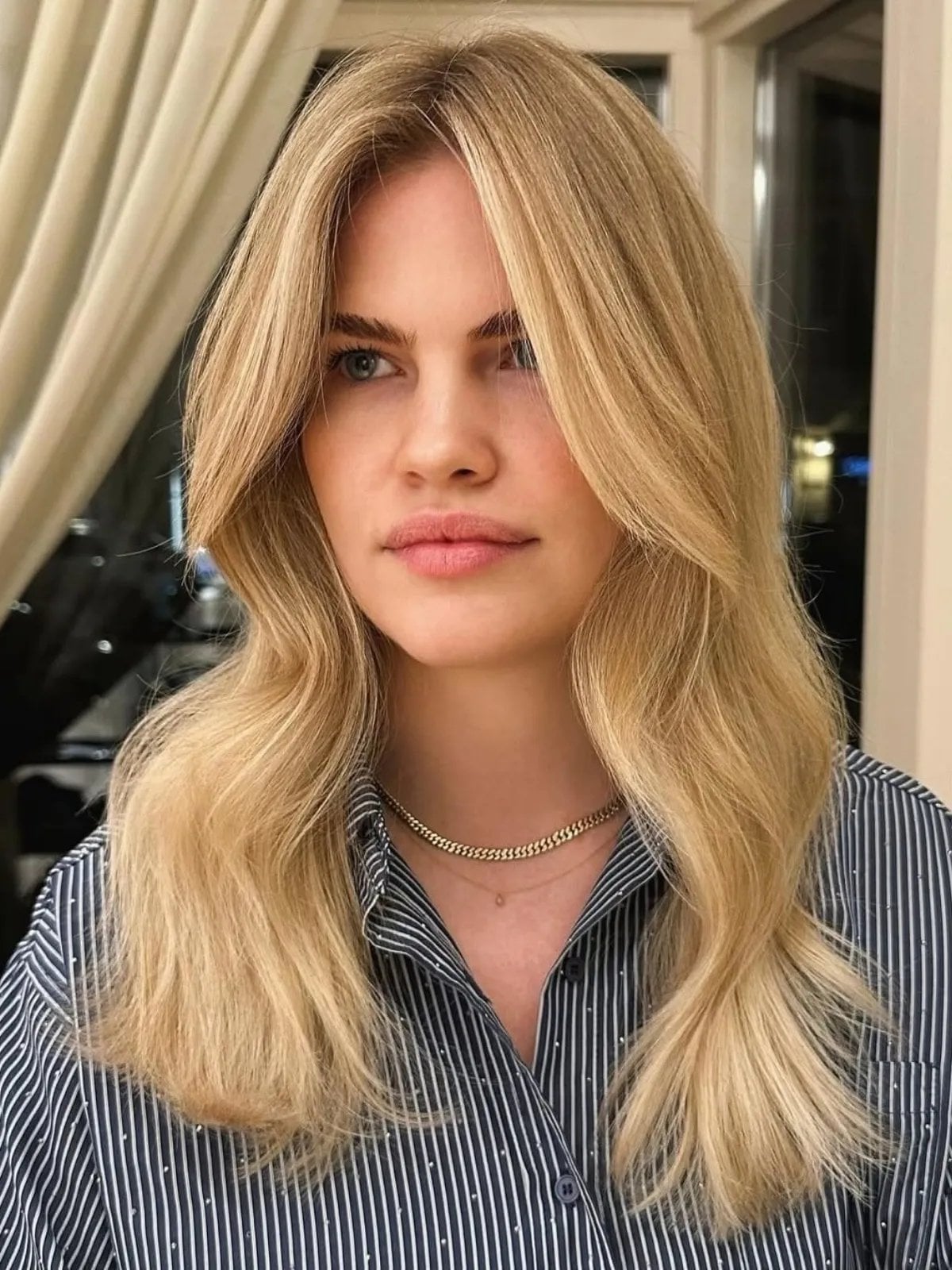
Thinking that any blonde will work for face-framing highlights is the mistake. Butter blonde can turn too warm if the highlights are placed too close to the root, leaving a stripe instead of a soft glow. Medium density, wavy hair at collarbone length with curtain bangs needs the lighter pieces to start an inch below the part line. Ask your colorist for: collarbone butter blonde with face-framing highlights. The drawback here is that face-framing pieces show regrowth sooner than the rest of the color, so expect a touch-up every six weeks to keep the brightness sharp rather than muddy.
Shoulder Length Honey Blonde Bob With Highlights
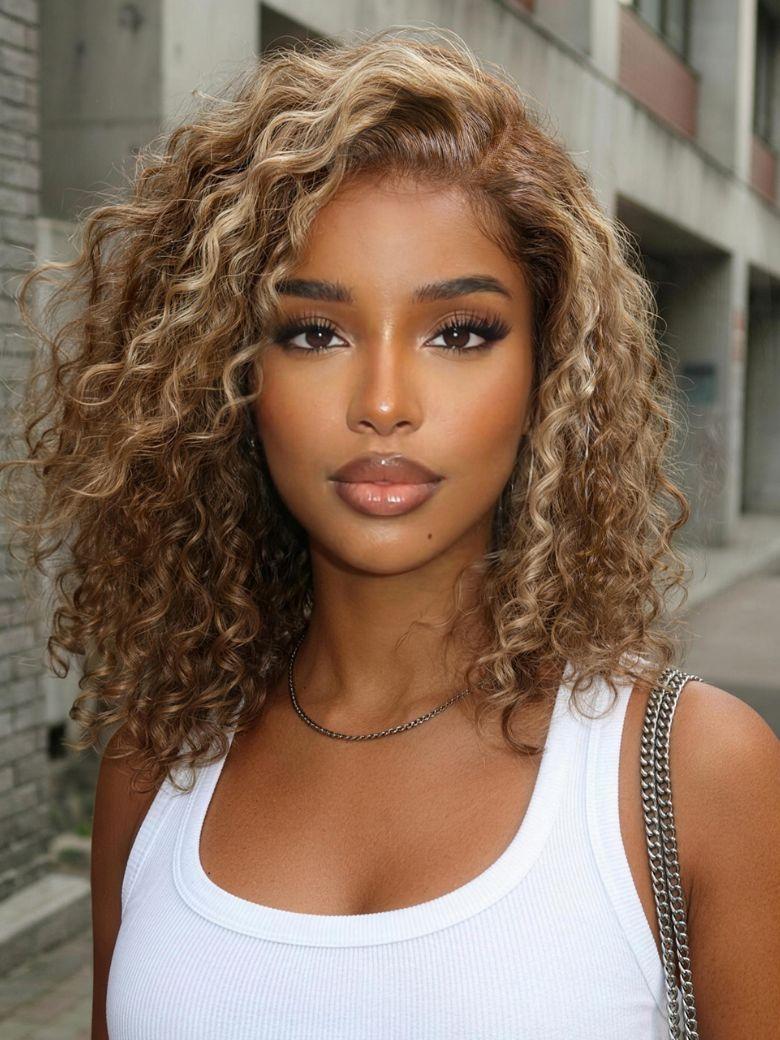
A honey blonde bob lands best in fall and winter, when the warm base adds depth under lower natural light. The collarbone-length cut keeps the silhouette neat while the dimensional highlights prevent the color from reading as one flat tone. Thick, wavy hair carries this well because the volume gives the lighter sections room to catch the eye. Ask your colorist for: shoulder length honey blonde bob with dimensional highlights. The bob itself is a year-round cut, but the honey tones feel deliberate against sweaters and scarves rather than washed out.
Collarbone Honey Blonde With Curtain Bangs
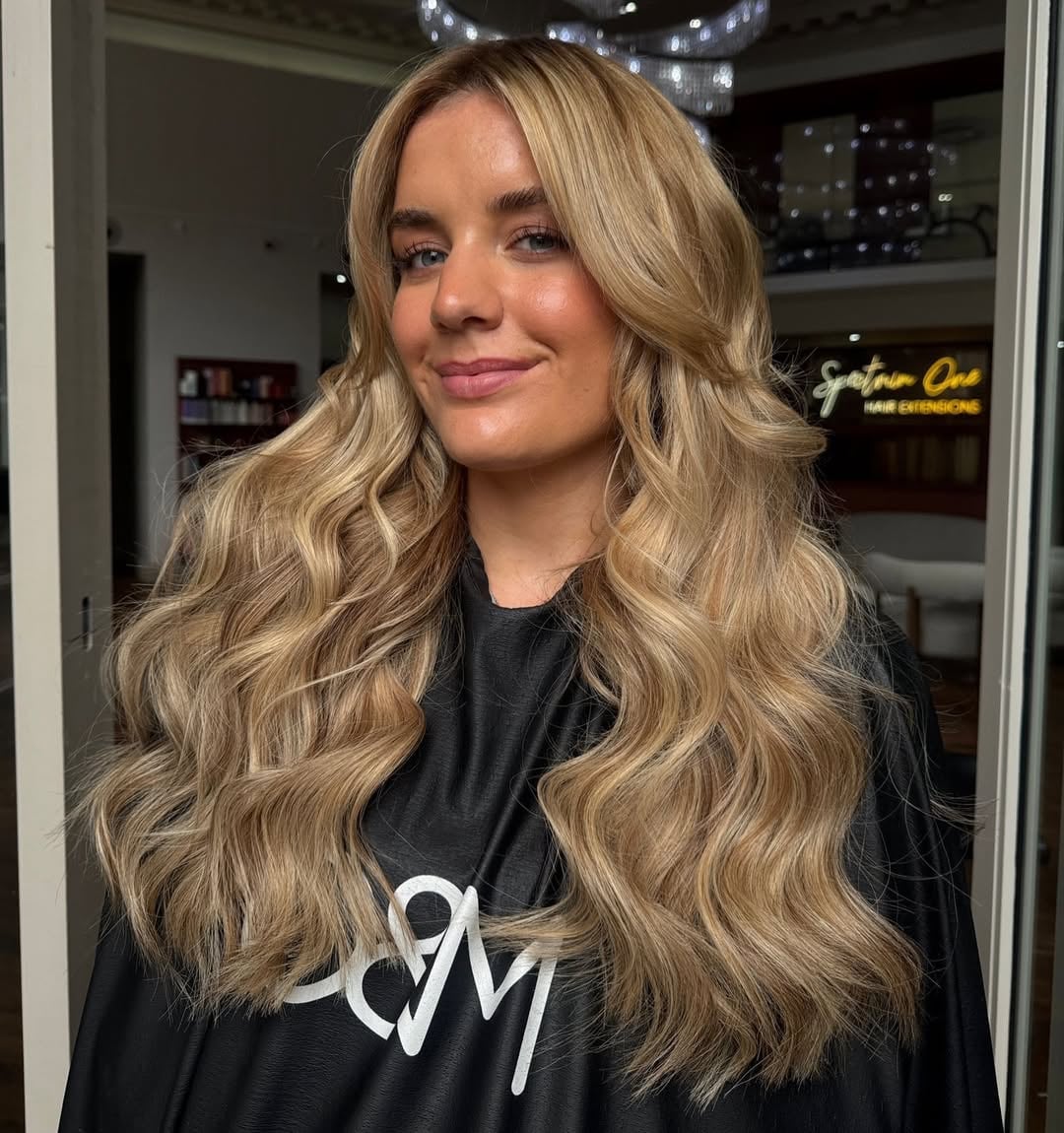
The curtain bangs here are cut to blend into the face-framing layers, so the transition from short to long is gradual. A bright honey blonde base with subtle highlights gives the collarbone length a glossy, natural finish. Thick, wavy texture needs the bangs blown dry with a round brush to keep the curve soft. Ask your colorist for: collarbone bright honey blonde with curtain bangs. Upkeep means trimming the bangs every four weeks to maintain the shape and a gloss treatment every six to eight weeks to keep the honey tone from dulling.
Mid-Back Ash Blonde With Honey Undertones
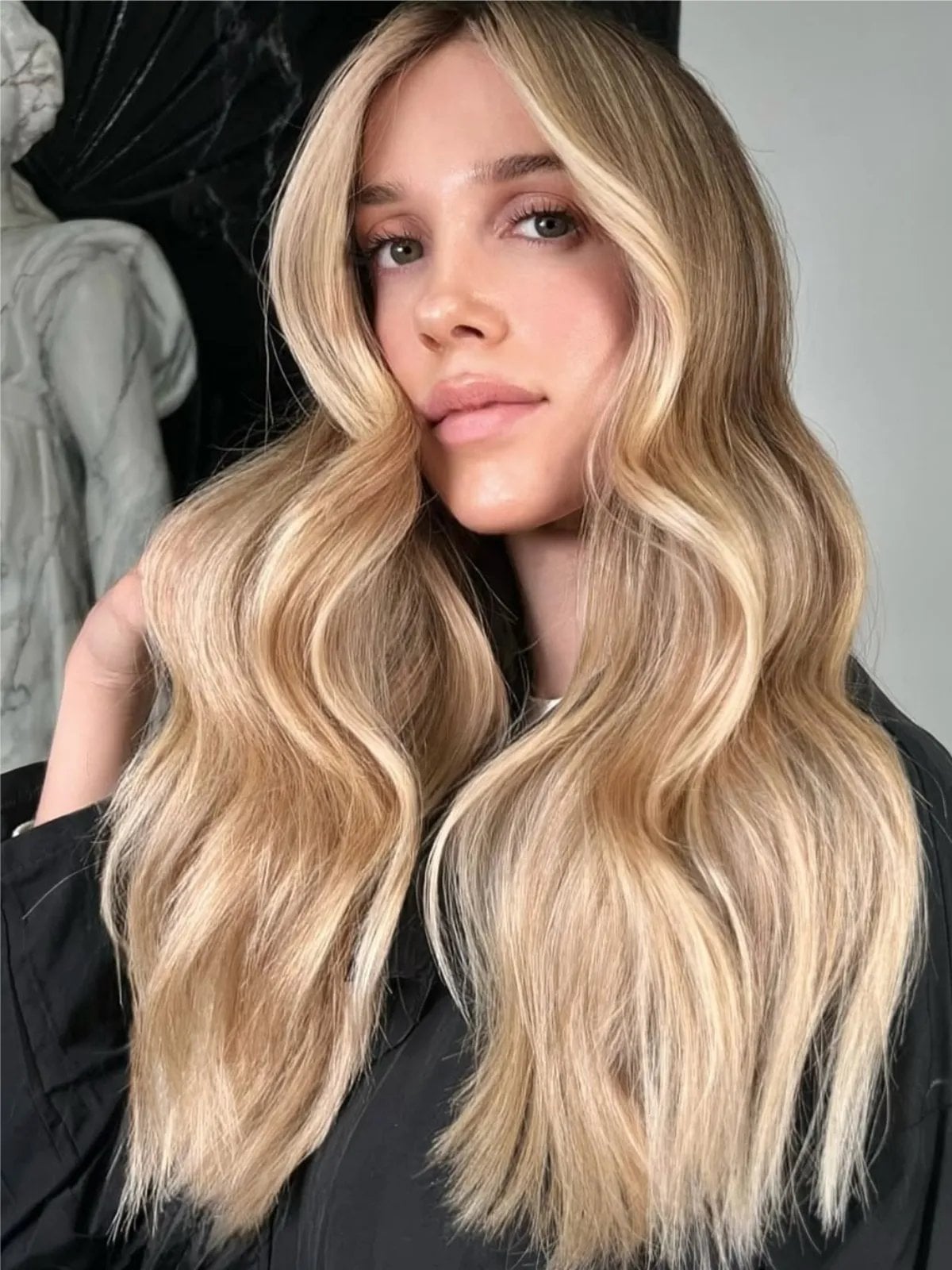
How do you ask for a cool-toned blonde that does not turn gray? The trick is specifying honey undertones within an ash base, which adds warmth without shifting to gold. Thick, wavy hair at mid-back length with curtain bangs shows the blend best in loose waves, where the ash and honey catch light differently. Ask your colorist for: mid-back ash blonde with honey undertones and curtain bangs. A salon does this in two steps: a cool toner over a warm base. A purple shampoo once a week keeps the ash from yellowing, but skip it on days you want the honey notes to peek through.
Mid-Back Dimensional Blonde With Honey Tones
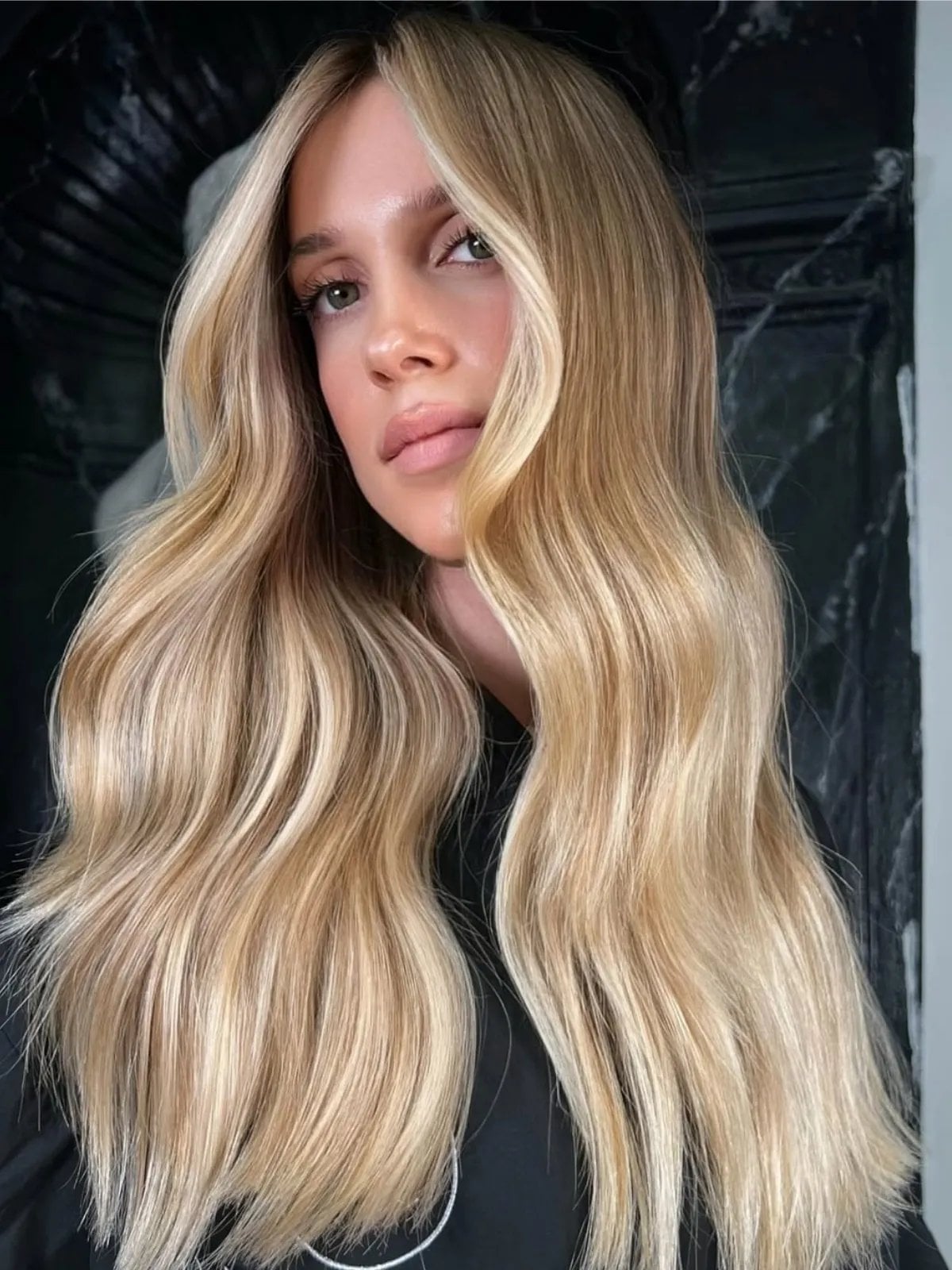
Dimensional blonde is a technical tightrope: too much contrast and it looks stripey, too little and it looks flat. This version finds the middle ground with an ash base and warm honey undertones woven through wavy, thick hair that hits mid-back. The curtain bangs and loose blowout keep the whole thing looking polished but not stiff.
Thick, wavy texture is the natural partner here, because the undertones need volume to reflect. Fine hair can work, but the dimension shows best when there is enough body to show different angles. Ask your colorist for: mid-back dimensional blonde with honey undertones and curtain bangs. A gloss treatment every six to eight weeks keeps the ash from pulling too cool and the honey from turning brassy.
Collarbone Peach Honey Blonde With Airy Bangs
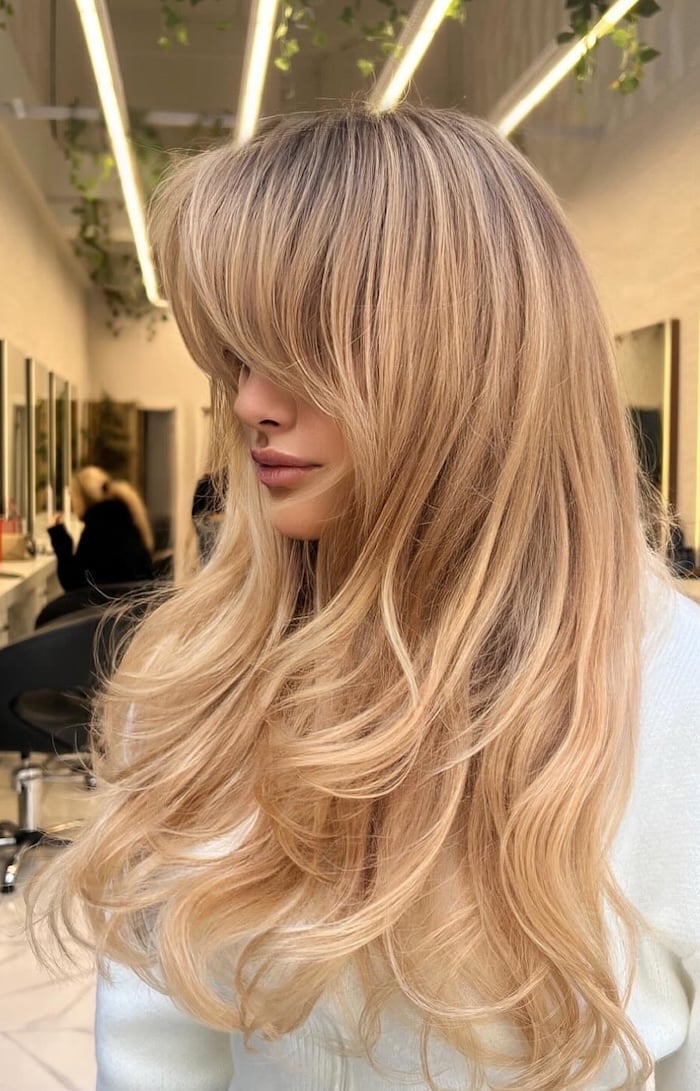
A peach honey tone is a warm blonde that leans slightly rosy, not pink, and it fades faster than a neutral blonde because the peach pigment is the first to wash out. On fine, wavy collarbone-length hair with airy curtain bangs, the effect is soft and lived-in, but the color needs a refresh every four to six weeks to avoid landing at a generic yellow. Ask your colorist for: collarbone peach honey blonde with airy curtain bangs. An air-dried finish works with the fine texture, and a color-depositing conditioner used once a week extends the peach between salon visits.
Collarbone Honey Blonde With Subtle Lighter Pieces
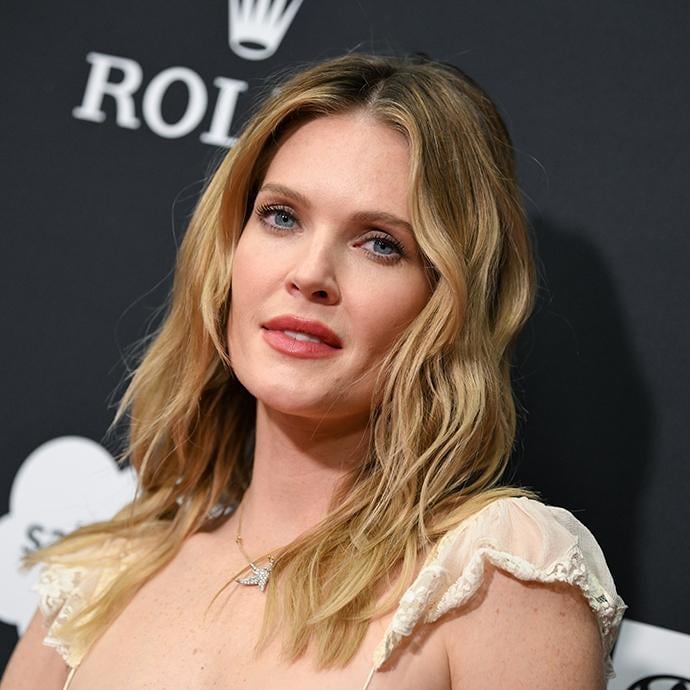
The placement of the lighter pieces here is the quiet hero of this design. They sit mostly around the face and through the mid-lengths, skipping the ends, which keeps fine, wavy collarbone-length hair from looking see-through at the hemline. The downside is that those face-framing pieces are the first to show grow-out, so the look reads best on someone willing to schedule a toner every six to eight weeks. Ask your colorist for: collarbone warm honey blonde with subtle lighter pieces and curtain bangs. A loose blowout gives the fine texture enough movement to make the dimension read without adding weight.
Mid-Back Straight Honey Blonde With Highlights
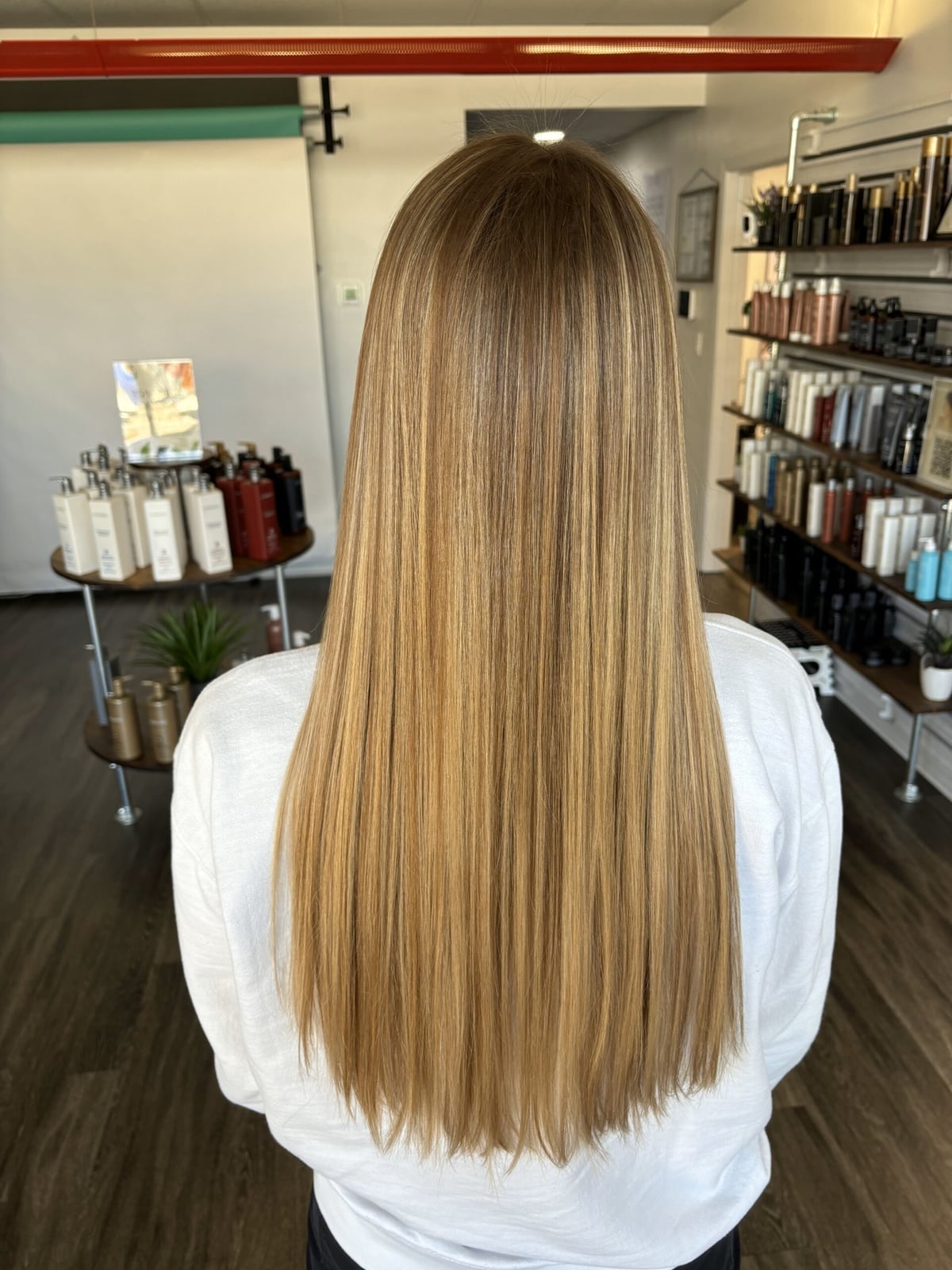
The mistake people make with a uniform honey blonde on straight hair is assuming it will look dimensional on its own. It will not. Without layers or texture, an even color reads as a single flat sheet from root to tip. This back view shows the fix: subtle highlights placed through long layers, so the color has somewhere to break. The hair is straight, medium-density, and air-dried, which means the highlights need to be fine and closely spaced to avoid looking chunky. Ask your colorist for: mid-back straight honey blonde with subtle highlights and long layers. A middle part and no bangs keep the grow-out low-maintenance, but the highlights themselves need a toner every eight to ten weeks to stay honey rather than golden.
Mid-Back Uniform Honey Blonde With Glossy Finish
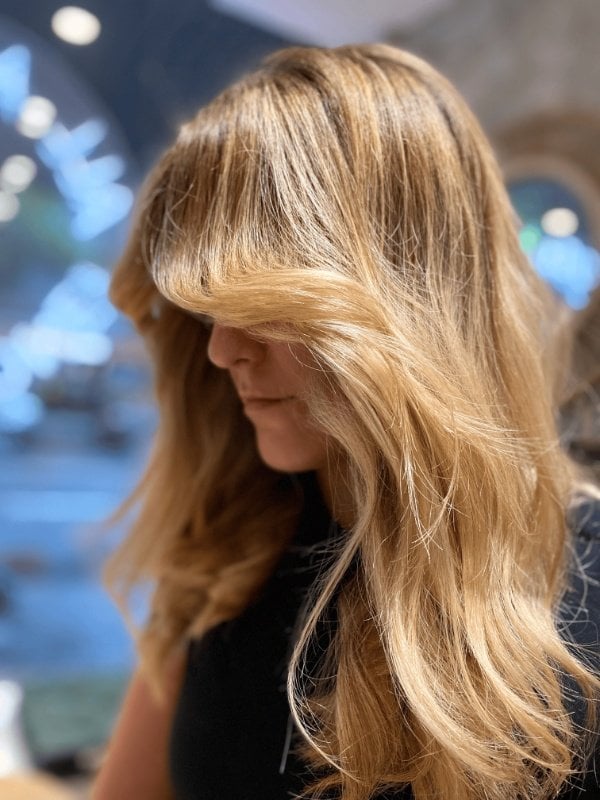
Full-coverage honey blonde is the color equivalent of a cashmere sweater: it does not rely on tricks, so the execution has to be flawless. This mid-back length lands it in an autumn sweet spot, when the warm tone echoes the season’s light without competing with summer’s sun streaks. The thick, wavy texture and smooth blowout give the glossy finish something to bounce off, which matters because a uniform color on limp hair can fall flat. Ask your colorist for: mid-back uniform warm honey blonde with a glossy finish. A shine spray or light oil at the ends keeps the reflection going, and the lack of highlights means grow-out is soft rather than stark.
Mid-Back Honey Blonde With Voluminous Waves
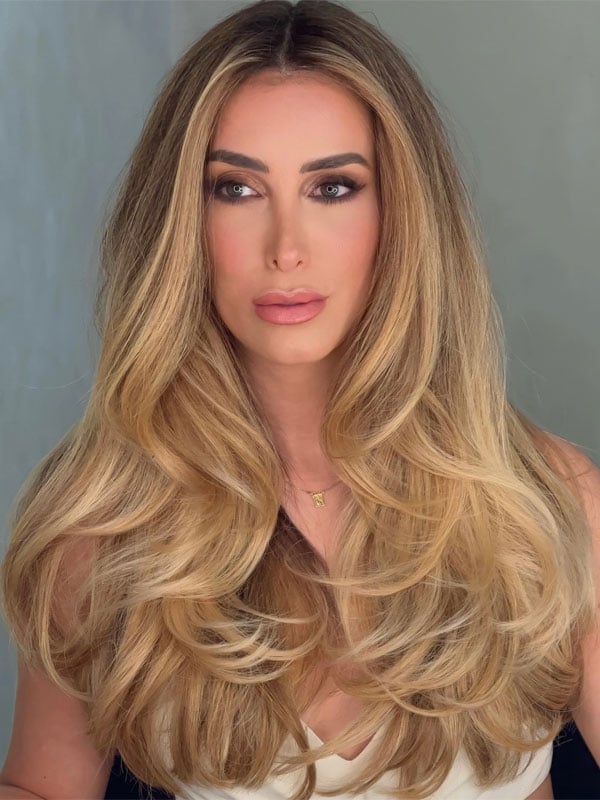
Volume starts with the root. This mid-back length starts with a rich honey blonde base, then subtle lighter highlights are painted in to keep the color from reading flat. The thick, wavy texture is blown out with a large round brush to lift at the crown, and the curtain bangs and face-framing layers are set in soft waves so nothing looks stiff. Ask your colorist for: mid-back rich honey blonde with voluminous waves and curtain bangs. Medium to coarse textures hold this shape longest; fine hair will need a volumizing mousse before the round brush.
Maintaining the warmth means a toner refresh every six to eight weeks, or the honey shade can skew too yellow. A large-barrel curling iron or foam rollers are faster than a full hot-roller set for the wave pattern. This is a salon-only color job, but the daily styling is under fifteen minutes once the blow-dry technique clicks.
Mid-Back Honey Blonde With Root Shadow Gradient
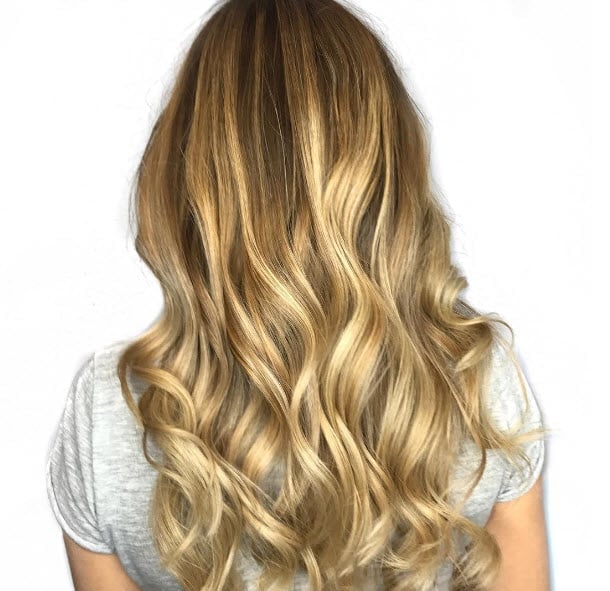
Ever wonder how to ask for hair that does not scream “I need a touch-up”? The root shadow here is painted about two inches down from the scalp in a tone just darker than the mid-lengths, then the honey blonde shade graduates to lighter ends. It is a back-view shot because the gradient is the whole point. Ask your colorist for: mid-back honey blonde with root shadow and lighter ends. Medium density, wavy hair of mid-back length benefits from this technique: the darker root softens the grow-out line, so you can stretch salon visits to ten or twelve weeks instead of six. No bangs means the gradient reads cleanly down the length.
Mid-Back Honey Blonde With Face-Framing Curtain Bangs
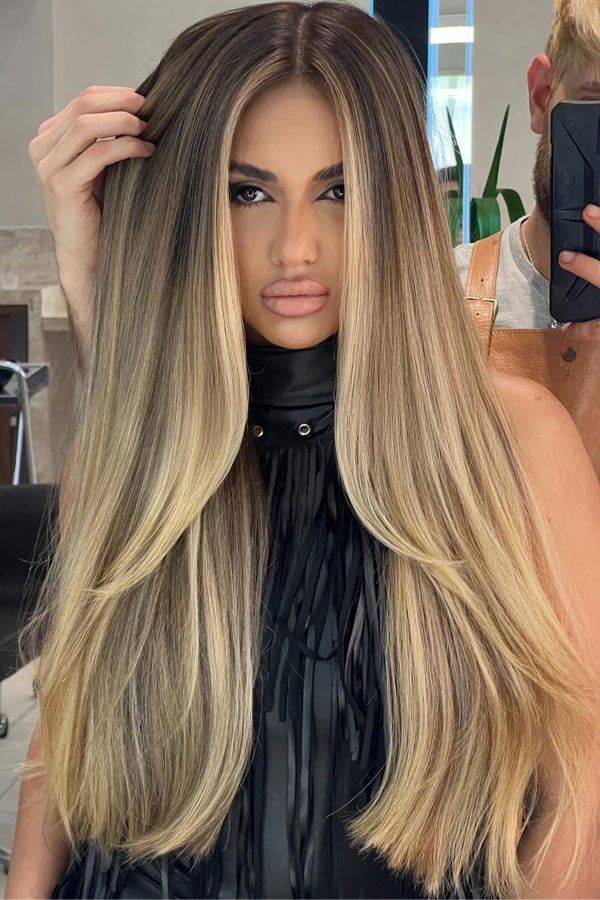
The glossy honey blonde color here is the anchor, but the curtain bangs do the heavy work of pulling the eye upward. Long, thick, wavy hair gets a smooth blowout with loose waves, and the face-framing layers start just below the cheekbone. This design suits anyone with a round or square face shape, since the soft angle of the bangs and layers breaks up the width. Ask your colorist for: mid-back honey blonde with curtain bangs and face-framing layers. The subtle highlights are placed on the front pieces to catch light when the hair is tucked behind an ear. Hair that is very fine or low density should skip the layers, because they can thin out the length too much.
The middle part keeps the curtain bangs symmetrical, which matters when you are not in the mood to re-style them every morning. A round brush on the bangs and a flat brush on the rest is the usual rhythm.
Chin Length Honey Blonde Lob With Waves
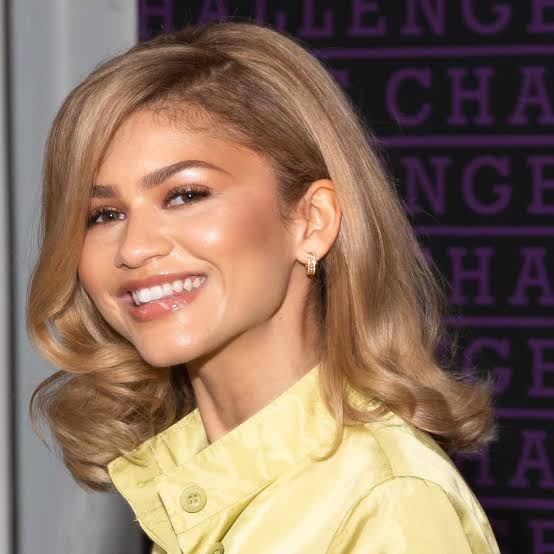
A chin-length lob with curtain bangs is the definition of low-fuss. The warm honey blonde color has subtle lighter pieces woven through the ends, and the soft waves are set with a medium-barrel iron. Fine, wavy hair of chin length holds this wave pattern well because the weight is not pulling the curl out. Ask your colorist for: chin length honey blonde lob with curtain bangs. A lob needs a trim every six to eight weeks to keep the line blunt at the chin. The curtain bangs grow out gracefully, so you are not back in the chair every three weeks. Blow-dry with a small round brush on the bangs, and the rest can air-dry with a wave cream.
Shoulder Honey Blonde With Balayage Highlights
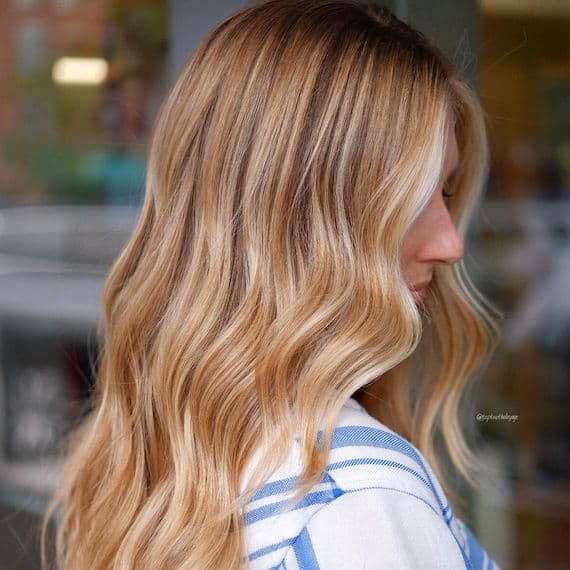
The balayage here is hand-painted from the mid-lengths to the ends, which creates a softer contrast than foils. Shoulder-length, medium density, wavy hair with a side parting gets dimensional highlights on a honey blonde base, and the loose waves make the lighter pieces look like natural sun exposure. Ask your colorist for: shoulder length honey blonde with balayage highlights. This is a salon-only technique because the placement depends on how the stylist reads the hair’s surface. The grow-out is genuinely subtle, so touch-ups land around ten to twelve weeks apart. A side parting works with the balayage placement to keep the heavier concentration of highlights on the side with more hair.
Mid-Back Honey Blonde Balayage Dimension, Wavy
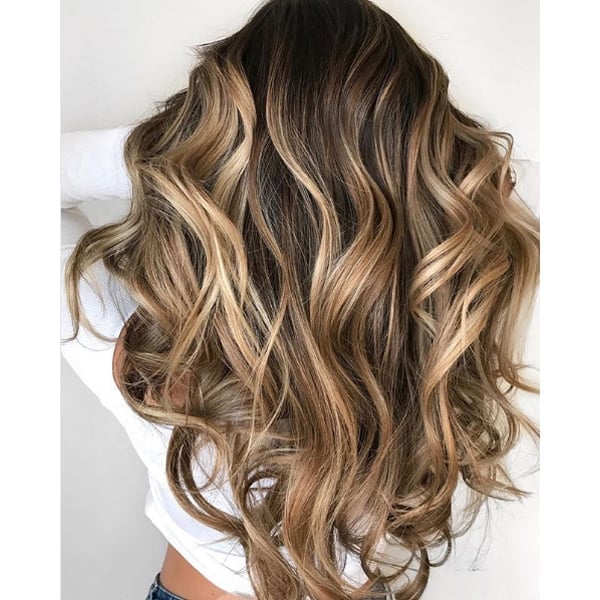
Ever seen a balayage that looks like one flat stripe from the back? That is the dimensional version’s main risk. The trick is in the application: a mid-back length with thick, wavy texture can handle a true balayage because the waves break up the color. Warm blonde tones painted through the ends, not the roots, create that depth without a harsh regrowth line. A blend of several honey blonde shades stops the color from settling into solid bands. If the painter pulls the lightener too high, you lose the graduated effect entirely. Ask your colorist for: mid-back honey blonde balayage with depth and dimension.
Thick, wavy hair of mid-back length works well here. The natural bend in the texture helps diffuse the color. Balayage touch-ups are typically needed every 10 to 12 weeks, which is longer than a full highlight schedule. Embrace those natural waves for styling and let the dimension speak for itself.
Mid-Back Honey Blonde With Lighter Highlights, Wavy
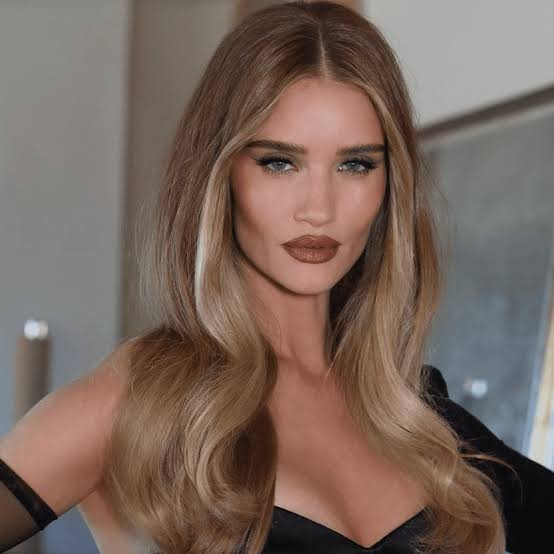
The loose waves expose the color distribution from the crown to the ends. A honey blonde base keeps the overall tone warm, while lighter blonde highlights punched through the top layers add brightness exactly where it catches the most light. The mid-back length gives enough real estate for the highlights to travel down the hair shaft without looking like they stop halfway. This is a color that lands beautifully in late summer and early fall, when the warmth of the base matches the seasonal shift in natural light. Ask your colorist for: mid-back honey blonde with lighter blonde highlights and face-framing layers.
Thick, wavy texture holds the contrast between the base and the lighter pieces without the two blending into a single shade. The face-framing layers can be styled with a blowout and a round brush to emphasize the brightness around the face. Highlights need toning every six to eight weeks to keep the lighter sections from pulling brassy.
Collarbone Honey Blonde With Face-Framing Pieces, Wavy
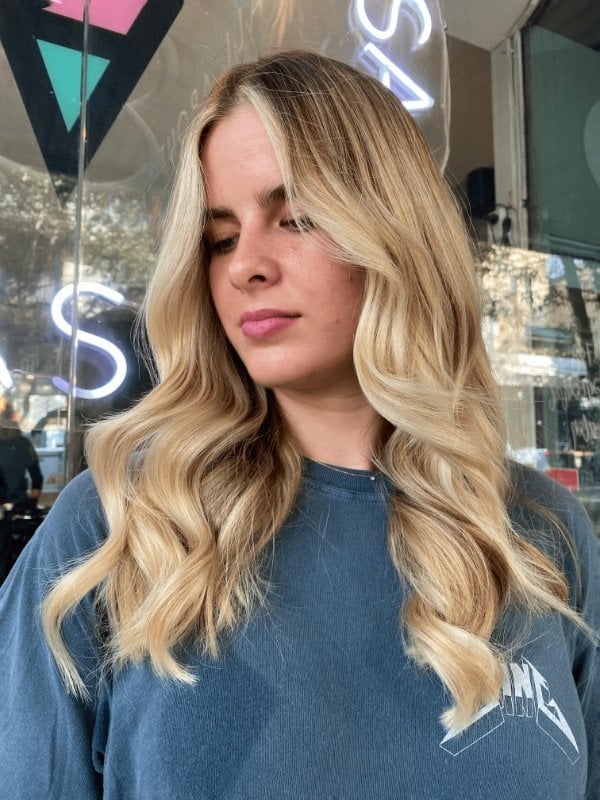
The side parting and loose waves tell you exactly how these face-framing pieces were built: the colorist painted subtle lighter sections only on the strands that fall forward from the part. A rich honey blonde base anchors the whole look, while those specific lighter pieces catch the eye without requiring a full head of highlights. The collarbone length keeps the face-framing sections short enough to feather around the jawline but long enough to tuck behind the ear. Ask your colorist for: collarbone rich honey blonde with face-framing pieces. A smooth blowout with a round brush emphasizes the contrast between the base and the lighter strands. This color needs toning every six to eight weeks to keep the honey tone from warming into brass.
Mid-Back Honey Blonde Balayage With Face-Framing Layers
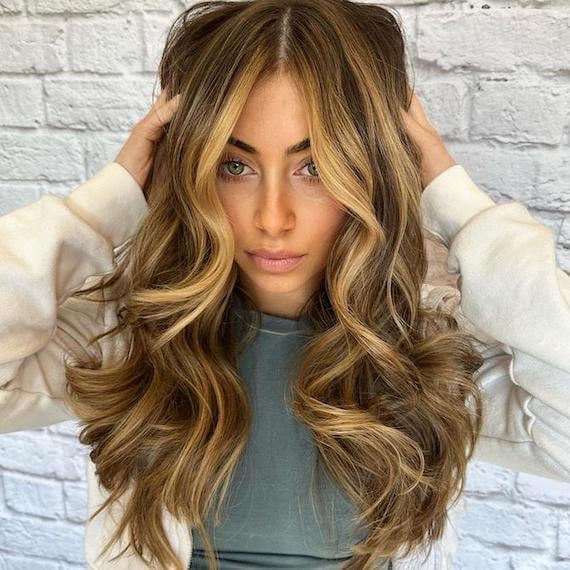
The curtain bangs and the face-framing layers share the same balayage treatment, which is what makes this design work. The colorist painted the lightener onto the sections that frame the face and the bangs, leaving the mid-back length with a more subtle, blended balayage. A middle parting exposes the symmetry: the lightest pieces sit on either side of the part and along the bangs, drawing attention to the face without needing heavy highlights through the entire length. The honey blonde balayage is warm but not brassy, with the depth at the roots giving the whole look a natural grow-out. Thick, wavy texture helps the color transition look soft rather than stripey. Ask your colorist for: mid-back honey blonde balayage with face-framing layers and curtain bangs. Blow-dry the bangs forward with a round brush to set their shape. Balayage offers a natural grow-out, so touch-ups land closer to every 10 to 12 weeks.
Final Thoughts
For a low-maintenance honey blonde, opt for balayage with a root shadow; for a bolder look, choose full highlights. Consider your natural texture when selecting styling, with waves enhancing dimensional colors.
- Refresh highlights or balayage every 8-12 weeks, depending on grow-out.
- Use a color-safe shampoo and conditioner to preserve tone.
- Incorporate a purple or gold toning conditioner weekly to maintain warmth.
- Protect hair from heat styling with a thermal protectant spray.
Honey blonde is a classic for a reason.